
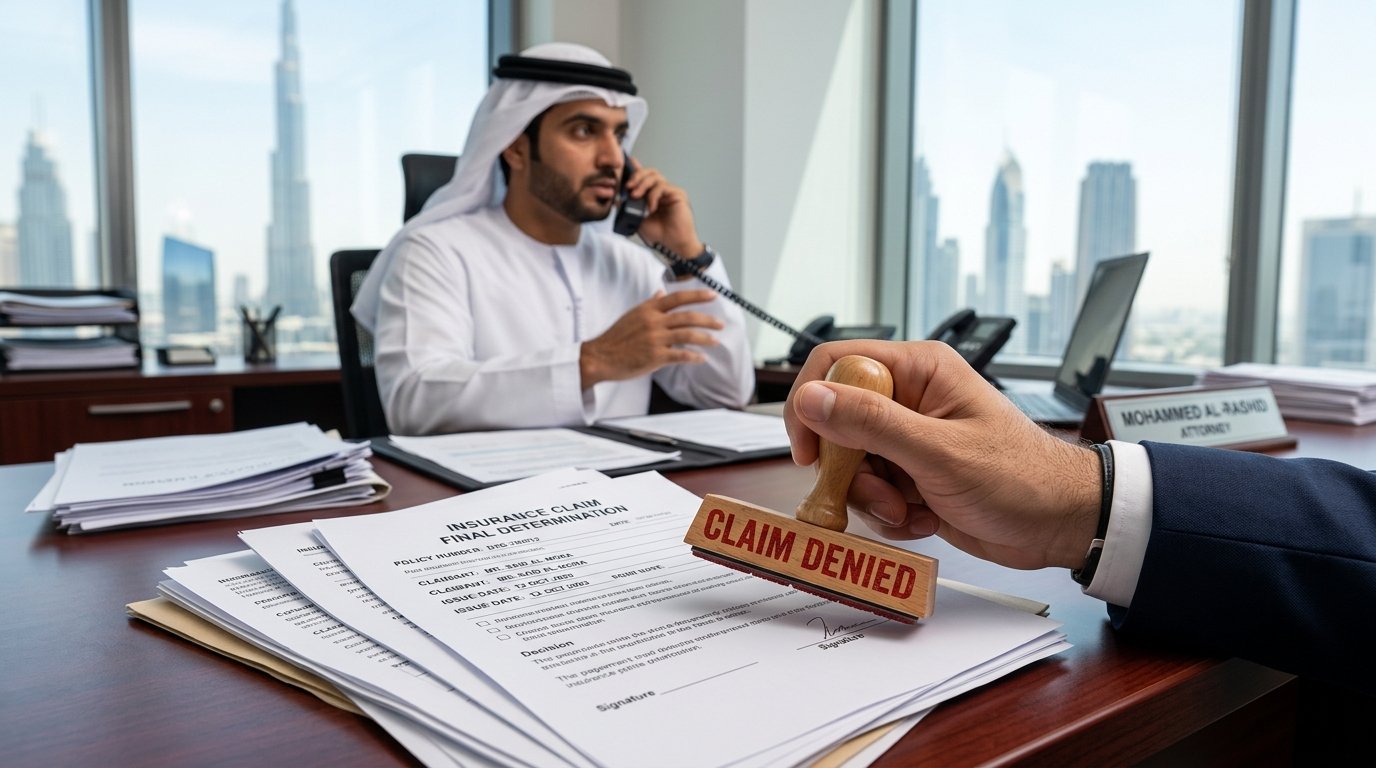
Insurance is supposed to provide peace of mind—a financial safety net protecting businesses and individuals from catastrophic losses. Yet, when a major incident occurs, policyholders frequently discover that their insurance company is more focused on finding reasons to deny the claim than on providing the promised coverage. In Dubai’s rapid-paced commercial environment, a wrongfully rejected insurance claim can have devastating financial consequences.
From massive construction projects and global shipping fleets to commercial property damage and complex medical malpractice cases, insurance disputes in the UAE involve high stakes and dense contractual language. Insurance companies deploy teams of loss adjusters and legal experts whose primary job is to minimize the insurer’s payout. To level the playing field, policyholders must understand the legal framework governing insurance in the UAE and how to effectively challenge a wrongful rejection.
This comprehensive guide explores the landscape of Insurance Dispute Resolution in Dubai, the most common reasons for claim denial, and the strategic steps required to secure your rightful payout.
Common Types of Insurance Disputes in Dubai
Insurance disputes in Dubai span a wide array of sectors, reflecting the emirate’s diverse economy. The most complex and frequently litigated areas include:
1. Construction and Engineering Insurance (CAR/EAR)
Dubai’s booming real estate sector relies heavily on Contractor’s All Risks (CAR) and Erection All Risks (EAR) policies. Disputes frequently arise over whether a defect is a design flaw (often excluded) or an execution error (covered), or regarding the extent of coverage for delays in start-up (DSU) following a physical damage incident on site.
2. Commercial Property and Business Interruption
Fires, floods, or unforeseen disasters can cripple a business. Insurers often dispute the valuation of the destroyed property or fiercely contest Business Interruption claims, arguing over the calculation of lost profits and the duration of the indemnity period.
3. Marine and Cargo Insurance
As a global logistics hub, Dubai sees numerous disputes involving marine cargo and hull insurance. These cases often involve complex questions of international maritime law, the seaworthiness of the vessel, and whether the damage occurred during transit or due to inherent vice (natural spoilage).
4. Professional Indemnity and Directors & Officers (D&O) Liability
When professionals (engineers, doctors, brokers) or company directors face lawsuits for negligence, they rely on their liability insurance to cover defense costs and damages. Insurers frequently attempt to deny coverage by citing non-disclosure of material facts at the time of policy renewal or arguing that the insured acted with deliberate fraud.
5. Medical and Health Insurance
While often lower in value per claim, medical insurance disputes are high in volume. Health providers and patients frequently clash with insurers over pre-existing conditions, the medical necessity of treatments, and adherence to complex pre-approval protocols.
Why Do Insurers Reject Claims? (And How to Fight Back)
Insurance policies are drafted by the insurer’s lawyers, heavily weighted with exclusions and conditions precedent. The most common grounds for rejection include:
Non-Disclosure or Misrepresentation
Under UAE law, the insured has a duty of utmost good faith to disclose all material facts when applying for insurance. If a business fails to mention a previous small fire, or a contractor fails to disclose a specific high-risk method of construction, the insurer may attempt to void the policy entirely. The Legal Fight: Your lawyer must prove that the undisclosed fact was not material to the specific risk that caused the loss, or that the insurer should have been aware of it through standard industry knowledge.
Breach of Warranties and Conditions Precedent
Policies often contain strict warranties (e.g., “The warehouse fire alarm must be tested weekly”). If a warranty is breached, insurers argue coverage is voided. Furthermore, policies have strict timelines for notifying the insurer of a loss. The Legal Fight: UAE courts generally require a causal link. If you breached the warranty regarding the fire alarm, but the loss was caused by a flood, an experienced lawyer can argue that the breach of the fire warranty should not invalidate the flood claim.
Exclusion Clauses
The core of most insurance disputes is the interpretation of exclusion clauses. Insurers will attempt to fit the cause of the loss squarely into an excluded category. The Legal Fight: Under UAE law (Article 1028 of the Civil Code), any arbitrary or purely printed exclusion clause that is not explicitly highlighted to the insured may be deemed void by the courts. Furthermore, ambiguities in the contract are generally interpreted against the party that drafted it (the insurer).
The Insurance Dispute Resolution Process in the UAE
When an insurance claim is rejected, policyholders have several avenues for recourse. The strategy depends on the value of the claim and the specific policy wording.
1. The Insurance Dispute Committee (IDC)
In a significant legal reform, the UAE established the Banking and Insurance Dispute Resolution Committees. For most insurance disputes, a claimant cannot directly file a lawsuit in the courts. Instead, the dispute must first be submitted to the Insurance Dispute Committee. The IDC is designed to be a faster, more specialized forum to review grievances against insurers.
The IDC reviews the submissions and issues a binding decision. If a party is dissatisfied with the IDC’s decision, they may then appeal to the competent UAE Court of First Instance within 30 days. Navigating the IDC requires precise legal drafting, as this initial stage often dictates the trajectory of any subsequent court appeal.
2. Litigation in the UAE Courts
If the dispute proceeds to the UAE courts (or if it falls outside the IDC’s jurisdiction), the litigation process relies heavily on court-appointed experts. In an insurance dispute involving a factory fire, for example, the judge will appoint an engineering expert to determine the cause of the fire and an accounting expert to quantify the business interruption losses. The effectiveness of your legal counsel in managing these experts—submitting clear evidence and robustly challenging the insurer’s loss adjusters—is critical to winning the case.
3. Arbitration
Many large commercial insurance policies (especially in construction and marine sectors) contain arbitration clauses. If an arbitration clause exists, the dispute bypasses the IDC and the local courts entirely and is resolved through private arbitration (e.g., at DIAC or the LCIA). Arbitration offers confidentiality and allows the parties to select arbitrators with specific insurance expertise, which is highly beneficial in complex technical claims.
Strategic Advice for Policyholders
To maximize your chances of a successful insurance payout, proactive management is required from the moment a loss occurs:
- Notify Immediately: Notify your broker and the insurer in writing immediately after the incident. Late notification is the most easily avoidable reason for claim rejection.
- Control the Narrative: Insurers will immediately send loss adjusters to investigate. Remember that loss adjusters work for the insurer. Engage your own independent loss assessor and legal counsel to manage communications and ensure evidence is documented favorably.
- Do Not Accept Lowball Offers: Insurers often exploit a business’s urgent need for cash flow by offering a fast, but severely reduced, settlement. Have an insurance lawyer review any settlement offer and release form before signing.
Conclusion: Level the Playing Field
Insurance policies are complex legal contracts designed by insurers to protect their own financial interests. When a high-value claim is on the line, policyholders who attempt to negotiate with the insurer’s legal team on their own are at a severe disadvantage.
By engaging specialized legal counsel, you send a clear message to the insurer that you will not accept an unjustified rejection. A skilled Insurance Dispute Resolution Lawyer in Dubai understands how to dismantle arbitrary exclusion clauses, navigate the Insurance Dispute Committee, and aggressively pursue your rightful claim through the UAE courts or arbitration.
