
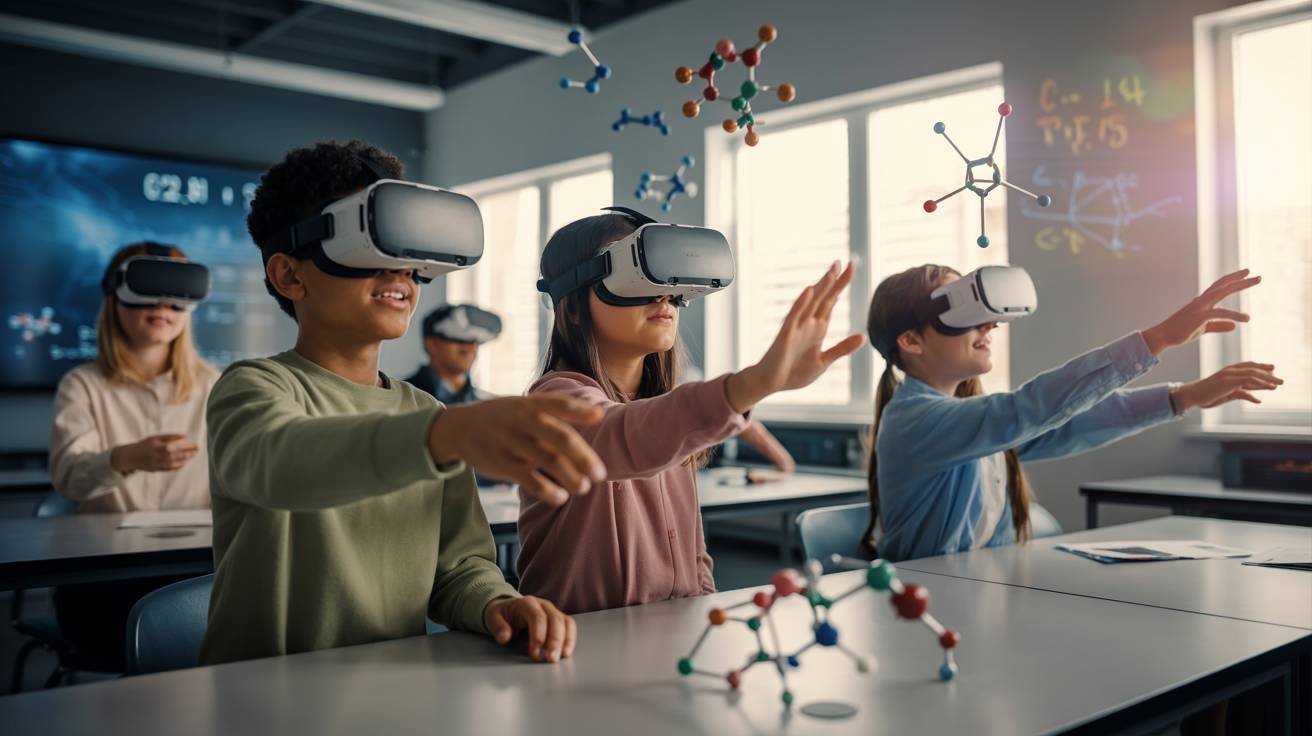
The New Frontier of Learning: Virtual Reality in the Classroom
In classrooms across the world, something electrifying is happening. Students are no longer just reading about chemical reactions or watching two-dimensional diagrams of planetary motion – they are stepping inside the atom, orbiting planets in full scale, and conducting experiments that once required multimillion-dollar laboratories. The buzz is unstoppable, the transformation irreversible. Virtual Reality (VR) has erupted into the educational landscape like a supernova, lighting up the dull corners of traditional learning and turning passive observation into immersive participation. Schools that once struggled to spark engagement are now witnessing a surge of excitement as learners strap on headsets and enter three-dimensional, fully interactive STEM environments. The sensory intensity is undeniable: the glowing molecules, the floating equations, the simulated gravitational fields – all choreographed with real-time physics that respond to every student gesture. It’s not just learning; it’s living the lesson. And the role of educator has never been more critical, shifting from lecturer to experience designer, guiding students through worlds that challenge every assumption about what education can be. Institutions that delay adoption risk falling behind as students gravitate toward schools offering these jaw-dropping, future-ready experiences. The clock is ticking – this isn’t the future of education anymore. It’s happening right now.
From Passive Reading to Active Exploration
For decades, the traditional classroom relied on textbooks and static images to convey concepts that demanded dynamic, multidimensional understanding. Imagine trying to explain quantum mechanics or molecular geometry with a chalkboard – an impossible feat for even the most passionate teacher. But with Virtual Reality, students can manipulate virtual molecules, bend light, and explore gravitational forces as if they were physically present in these microscopic or cosmic realms. Every movement, every reaction, becomes a discovery that locks into memory because it’s experienced firsthand. The role of educator evolves into that of a navigator, steering students through scientific adventures rather than dictating information. Teachers are no longer bound by limited resources or physical constraints; VR offers limitless potential. Schools embracing this change are seeing test scores climb and retention rates soar because students aren’t just memorizing – they’re internalizing. The energy in VR-driven classrooms is palpable; the buzz of curiosity is contagious. Those still relying solely on textbooks risk losing the attention of a generation raised on interaction and immersion. The time to integrate VR into STEM education is now, before this wave of innovation leaves the old models obsolete.
The Power of Immersion: Why Engagement Skyrockets in Virtual Environments
When a student slips on a VR headset, the classroom disappears, replaced by vivid, responsive worlds where knowledge feels tangible. In a physics lesson, they might find themselves balancing forces on a virtual bridge, feeling the subtle vibration of tension as they adjust cables. In a biology class, they can stand inside the human heart, watching blood pulse through translucent chambers. The immersive quality of these experiences triggers deep emotional and cognitive engagement – learning through doing rather than reading. Studies have shown that retention rates for experiential learning can exceed 75%, compared to less than 10% from traditional lectures. The role of educator here becomes even more profound, as teachers orchestrate these sensory experiences, ensuring students grasp the science behind the spectacle. Engagement transforms into excitement, and excitement fuels mastery. Institutions that have already implemented VR into their STEM curriculum report unprecedented enthusiasm – students arrive early, stay late, and crave more. The fear of missing out (FOMO) on such a transformational learning method is real, and forward-thinking schools are capitalizing on it. To ignore VR now is to ignore the most potent engagement revolution education has ever seen.
Breaking Down Barriers: Accessibility and Equal Opportunity Through VR
One of the most extraordinary aspects of VR technology is its power to democratize access to high-quality education. For students in remote areas or underfunded districts, virtual reality opens doors once thought permanently closed. Complex chemistry experiments that once required expensive materials can now be performed virtually – without risk, waste, or financial burden. Advanced robotics, aerospace simulations, and architectural modeling can all be experienced within the same digital ecosystem. The role of educator becomes that of an equalizer, ensuring every student, regardless of location or income, has access to world-class STEM instruction. Imagine a student in a rural village learning the same intricate engineering principles as someone in a top-tier city school – both standing side by side in the same virtual laboratory. The emotional power of that equality is staggering. VR levels the playing field and accelerates inclusion, bringing the dream of global educational equity closer to reality. As the cost of VR hardware continues to fall, schools that move fast will gain a head start in providing life-changing opportunities for their students. Those who hesitate risk widening the gap and losing a generation to digital disparity.
Redefining the Role of Educator in the Age of Virtual Reality
The introduction of Virtual Reality into STEM education doesn’t diminish teachers – it amplifies their influence. The role of educator evolves from information dispenser to mentor, from controller to curator of experiences. Teachers are no longer limited by blackboards and lab schedules; they are empowered to create, guide, and inspire through dynamic virtual learning spaces. In a VR-enabled class, an educator can lead students through a guided tour of Mars, pause mid-mission to explain atmospheric composition, and even simulate real-time problem-solving under pressure. This shift requires new skills – digital fluency, adaptability, and creativity – but the rewards are immense. Educators who embrace VR report deeper student relationships, stronger engagement, and a renewed sense of purpose. They become architects of curiosity, crafting tailored VR lessons that spark exploration. Professional development programs and certifications are emerging rapidly, helping teachers master this new frontier. Schools that invest in training their staff now will define the gold standard of STEM learning for years to come. The clock is ticking; the evolution of teaching has already begun, and the world is watching who leads the charge.
Industry Adoption and Real-World Success Stories
Major educational institutions, from MIT to public high schools across Asia and Europe, are already reaping the benefits of VR integration. NASA’s Jet Propulsion Laboratory uses immersive VR to train engineers, while medical schools leverage it for realistic surgical simulations without risk to patients. In STEM classrooms, students can now replicate these same advanced experiences at a fraction of the cost. The role of educator here mirrors that of a facilitator guiding students through industry-grade training environments. Imagine high schoolers designing rockets under the same conditions as aerospace engineers or solving chemistry challenges within molecular scales visible only through VR. The results are staggering – student enthusiasm has skyrocketed, dropout rates are declining, and career readiness is improving dramatically. A 2024 report by PwC found that VR learners are four times faster to train than traditional learners and nearly 300% more confident in applying new skills. Schools adopting VR early are gaining competitive prestige and attracting record enrollment numbers. Those who hesitate will watch their brightest students migrate toward institutions that offer these dynamic, real-world learning experiences. The momentum is unstoppable; the transformation is already rewriting the future of education.
Security, Licensing, and Verified Payouts: Building Trust in Educational Technology
As VR becomes integral to the classroom, questions about security, licensing, and reliability naturally arise. Responsible institutions are addressing these concerns head-on by partnering with verified providers offering licensed software, transparent pricing, and secure student data handling. Platforms like Oculus Education and ClassVR ensure end-to-end encryption, verified content, and responsive customer support for educators. The role of educator in this environment extends to gatekeeper – ensuring the virtual tools used in class meet ethical and technical standards. These verified ecosystems not only protect students but also elevate trust between parents, schools, and technology providers. Verified payouts for school licensing, warranty guarantees, and compliance with child safety laws make VR integration not just innovative but also responsible. As with any revolution, credibility matters. Institutions that adopt certified, licensed VR tools stand apart as leaders in secure, reliable digital education. The message is clear: this is not experimental anymore – it’s trusted, tested, and transforming classrooms safely across the globe.
FOMO Is Real: Why Schools Can’t Afford to Wait
Every semester that passes without VR integration is a lost opportunity – an entire cohort of students missing out on one of the most powerful educational tools ever developed. Parents are beginning to demand it. Students are talking about it. Competing schools are advertising it. The sense of urgency is growing by the day. Forward-looking institutions understand that VR isn’t a luxury; it’s the next baseline. The role of educator in this fast-moving landscape is to stay ahead, adapting and innovating before students look elsewhere for engagement and inspiration. The fear of missing out is not abstract – it’s measurable in enrollment declines and lower student satisfaction. When schools fail to modernize, they don’t just lose prestige – they lose relevance. This is the pivotal moment where action defines legacy. Implementing VR tools now means attracting a new wave of eager learners, empowering teachers, and securing a place at the forefront of modern education. Those who delay risk being remembered as institutions that waited too long. The opportunity is here; the urgency is undeniable.
How to Get Started: The Path to VR Integration
Integrating VR into STEM education doesn’t have to be daunting. Many institutions begin with pilot programs, testing a few headsets and curated lesson modules before scaling. Start with subjects like biology, physics, or engineering – disciplines that thrive on visualization and experimentation. Seek platforms that provide pre-licensed, teacher-friendly content, training resources, and reliable support systems. The role of educator remains at the heart of this transformation, translating immersive experiences into structured learning outcomes. Schools should also involve parents and stakeholders early, showcasing how VR improves comprehension, engagement, and safety. Grant opportunities, partnerships with tech companies, and educational subsidies can dramatically lower costs, making VR integration accessible even for smaller districts. The most successful institutions are those that act decisively, combining vision with strategy. Once the first headset is powered on, the difference is instantaneous – students’ eyes widen, curiosity ignites, and learning transforms from an obligation into an adventure. The urgency to act has never been greater. The path is clear, and the tools are ready. The question is – will your institution take the leap?
The Future of STEM Education Has Arrived
The transformation sweeping through STEM education is nothing short of historic. Virtual Reality has turned imagination into infrastructure, possibility into practice. Classrooms that once echoed with boredom now vibrate with energy as students build, explore, and discover in breathtaking virtual worlds. The role of educator stands as the guiding compass, steering this revolution toward meaningful, equitable learning. Every data point, every testimonial, every real-world success story reinforces the same truth: VR is no longer an experiment – it’s the new foundation of global education. Schools that move now will define the future; those that hesitate will struggle to catch up. The sense of urgency is unmistakable, and the window of opportunity is narrowing fast. This is the moment to act, to invest, and to transform. The tools are proven, the technology secure, the outcomes undeniable. Education has entered a new dimension – don’t let your students watch from the sidelines. Step into the future today.
If you found this helpful, you might also want to explore How to Structure Academic Essays for more insights on this topic.
